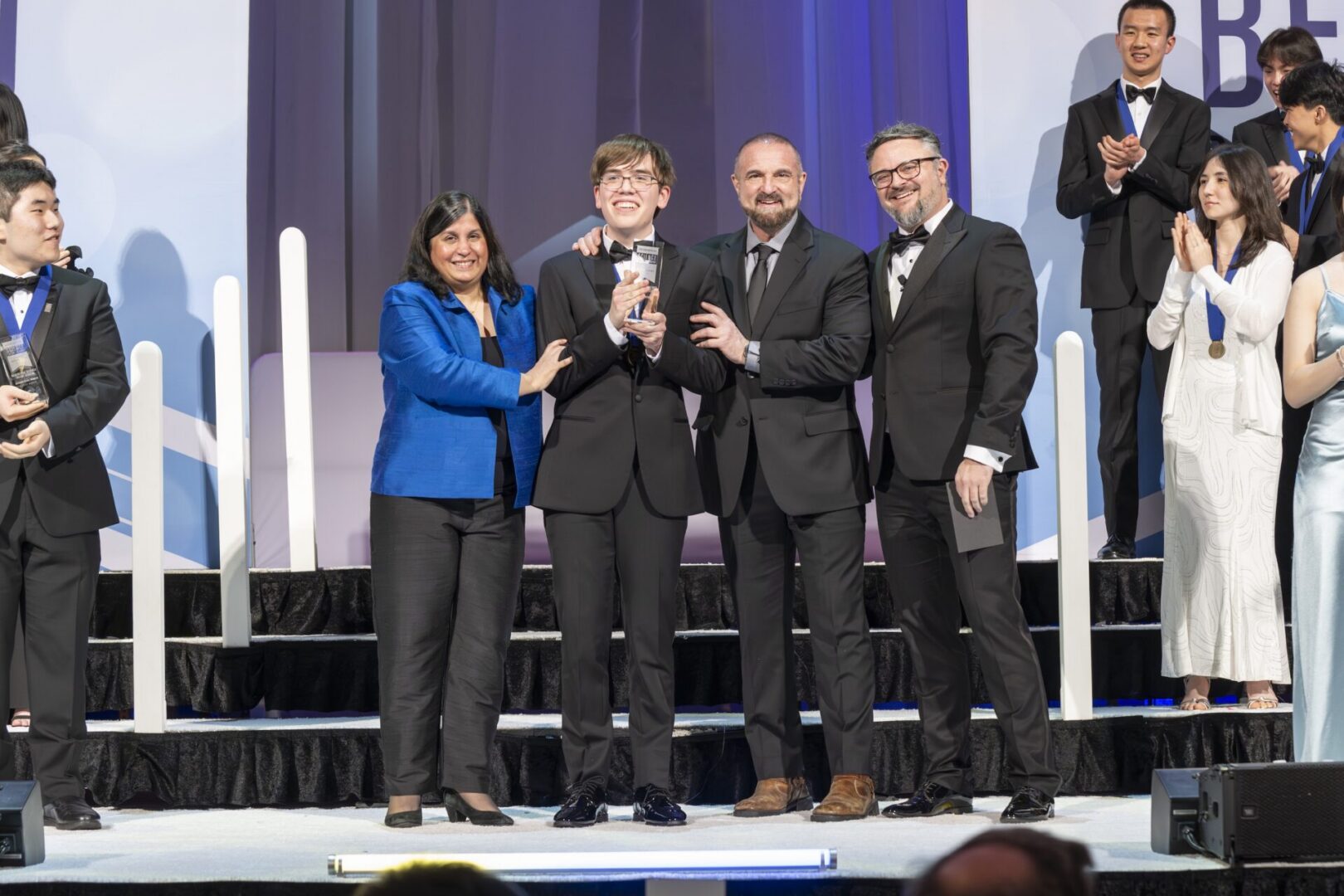
A State College Area School District student won first place on Tuesday night in a national math and science competition for high school seniors billed as the oldest and most prestigious of its kind.
Connor Hill, a 17-year-old Delta High School senior, took the top honor and its accompanying $250,000 prize for his discrete geometry research project in the 85th Regeneron Science Talent Search produced by Society for Science. The prize money is the largest scientific prize available to a high school student in the United States, according to Society for Science.
Hill, of Port Matilda, beat out a pool of nearly 2,600 applicants, including 40 finalists, to win first place. Awards were presented at a ceremony on Tuesday night at the National Building Museum in Washington, D.C.
“It was truly unreal to just have my research recognized,” Hill said by phone on Tuesday night, minutes after learning he received the honor. “I was not expecting it, and so it was just such an amazing feeling.”
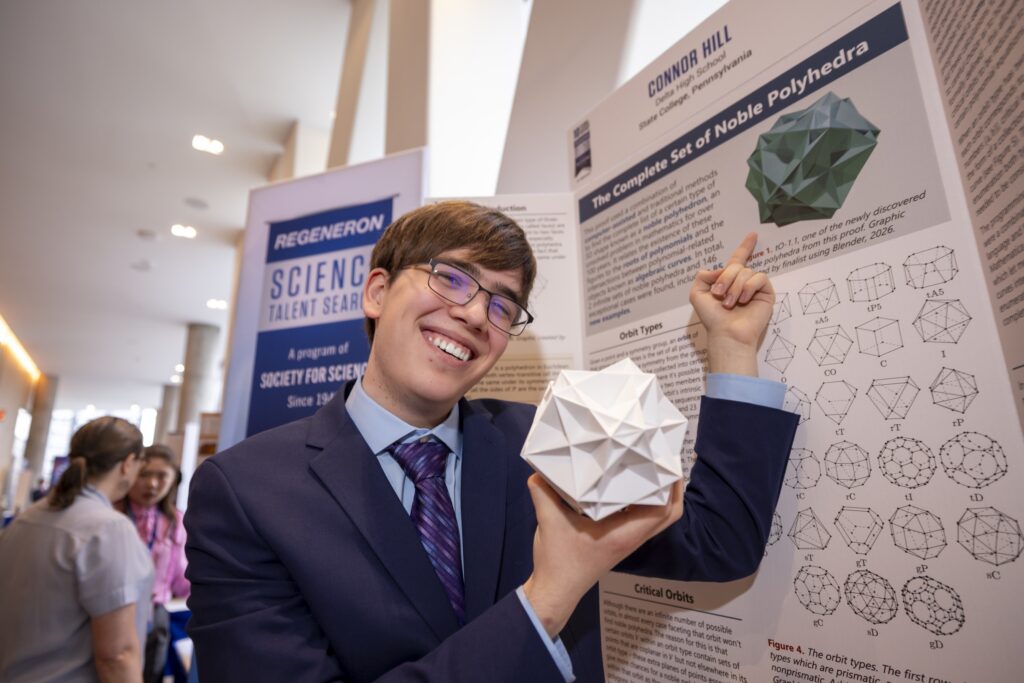
Hill won for his research that discovered a way to identify all the possible “noble polyhedra.”
A polyhedron is a shape with flat sides and straight edges, such as a cube or a pyramid. In a noble polyhedron, all the faces are the same shape, and the angles at each corner are the same. Mathematicians knew of two infinite families of noble polyhedra and 61 isolated examples, and that more likely existed, according to the project profile.
Hill wrote a computer program to work through all conceivable ways to build a noble polyhedron and concluded that in addition to the two known infinite families, there are 146 noble polyhedra.
“I did this through what’s called a computer-assisted proof,” he said. “The proof is too long to be written by hand by a human, so basically, you tell a computer how to prove your result, and then the computer does it in tandem with people. So it’s pretty cool.
“People have found a lot of examples of these noble polyhedra. There was no sort of strategy of finding that complete list. So I came up with a new idea, initially just to try and find some new examples, but it sort of led to this larger proof that the list is complete.”
Hill said he has long been interested in geometric figures and learned of the longstanding noble tetrahedra problem online.
“I’ve been interested in geometrical figures similar to these ones ever since I started high school,” he said. “But for this problem in particular, it’s been about two years, maybe three years that I’ve been working on the problem, sort of chipping away at it.”
The 40 finalists were awarded a total of $1.8 million in prize money and joined a distinguished group Science Talent Search alumni that includes 13 Nobel Laureates, 23 MacArthur Fellows and 14 winners of the National Medal of Science.
“Congratulations to the winners of this year’s Regeneron Science Talent Search,” Maya Ajmera, president and CEO of Society for Science and executive publisher of Science News, said in a statement. “Their bold vision and perseverance reveal what the next generation of problem solvers truly looks like—and why our future is in capable hands. Their creativity, ambition and courage to confront the world’s toughest challenges are exactly what this moment demands.”
Hill will use his prize money toward his college education. He’s still deciding what school he will attend, but plans to study mathematics.
The son of Nikki and Brian Hill, Connor Hill is also a nature enthusiast who volunteers at Shaver’s Creek Environmental Center’s summer camp. He’s a member of the Centre County 4-H Robotics Club, where he said he’s learned “pretty much everything I know about engineering,” runs a community-based segment on his school news program and practices juggling for several hours a week.
He’s been in Washington, D.C. since Thursday for Finalists Week, which included in-person judging, panel discussions and a public project exhibition, among other activities.
“It’s a really eventful week because there’s judging, there’s a field trip. You actually get to go to Capitol Hill,” he said. “There are just so many opportunities and they cram a whole lot in just a week.”